Tuesday, January 16, 2024

GHOST RIDER - VOLUME 10 - BY BEN PERCY (2022 - 2023) ~ PART TWO

 ABANDONED BROTHERS, ADAMANTIUM, & ANGST -

GHOST RIDER VOLUME 10

Part Two


Welcome to the second half of Blood Work's overview and analysis of Ghost Rider Volume Ten, written by Ben Percy, edited by Darren Shan, with artwork primarily by Cory Smith. In Part One we discussed issues one through ten, comprising roughly half of the story. 

For that whole post, click on the link here: GHOST RIDER VOLUME TEN (2022): PART ONE

In Part Two we'll tackle the rest of the volume and the tie-in issues. We've covered the first two story arcs, which wasn't perfect, but had a lot of good elements in it. Now let's dive into the rest.

Issue ten ended with a tease for the next story arc, revealing the return of Johnny Blaze's brother and Blood Work's personal favorite Ghost Rider: DANNY KETCH

The third story arc begins...

Cory Smith takes a break for issue eleven, artist David Wachter filling in as the guest artist, and he does a great job here. Johnny and Talia take to the road towards Savannah, Johnny riding the villain Exhaust as a motorcycle (apparently Exhaust is a motorcycle? This was not setup very well and is rather strange to see). This issue's sole goal is resolving Exhaust's story. There is some preachy narration again here, about looking inward and trying to fix our own failings before judging others. This biblical sentiment is coupled with a Nietzschean philosophy of those who do battle with monsters becoming monsters themselves. The end of this thought process has Johnny deciding to make a conscious effort to better himself, to let go of the things ruining his life and those he cares about, even if it means getting rid of things in his life that he enjoys; thus the choice to bury Exhaust and let go of the darkness inside himself. It's a genuinely heroic sentiment, one that's universally relatable and an evergreen philosophy.

The end of issue eleven sees Johnny and Talia arriving at last at Savannah, Georgia to a massacre. Savannah was one of the towns Blackheart had infested with his demons, the narrative flowing naturally from the previous story arc into the next. Issue twelve showcases Savannah decimated, littered with bodies and crawling with demons. Cory Smith returns to art duties and tops himself here with some of the finest art in the series yet. Ghost Rider uses a flaming sword to hack apart a cemetery full of demons in a visual feast for the eyes. We learn here that a different Ghost Rider was responsible for the massacre. Talia performs a magic rite to once again invade Johnny's mind and sees an image of Johnny's brother, Danny Ketch, corrupted. Just a side comment here: This method of Talia's to invade Johnny's mind is visually more interesting than an exposition dump, I'll grant the writer and editor that. But it leaves Talia's character feeling obtrusive, invasive, and thieving. In short, it only leaves us with another negative impression of her.

Cory Smith's incredible artwork!

Issue thirteen opens with a scene from months ago in which Danny Ketch is confronted by Dr. Diyu, a woman working on the science of Hell. She convinces Danny to join her project, to sign over his body to her for research. In return she'll grant him freedom from the Ghost Rider. Flash forward to the present and Johnny and Talia follow the trail to yet another massacre in Myrtle Beach where the lone survivor describes a Ghost Rider-like figure as the culprit. Flash back to the past with Danny and Dr. Diyu where she forces him to battle a hulking demon. After defeating the demon, fed up with her crap, Danny prepares to leave. By telling him a sob story about how her little brother was taken by demons, Dr. Diyu successfully manipulates Danny into helping her, even when it's apparent to us readers that Dr. Diyu is obviously up to no good.

The old saying, "Fool me once, shame on you. Fool me twice, shame on me," comes to mind. I think we need to add, "Fool me three times, shame on the writer and editor." For a man who was manipulated and controlled by the angel Zadkiel in his last significant appearance, and then used again by the demon Belasco in his previous appearance, Danny comes across ridiculously naïve, borderline stupid. When we first meet Danny in this arc he does feel like himself, so credit to the writer for capturing Danny's character fairly well. But having him fall for the same trick for a third time is so very unoriginal and tired, as if Marvel editorial only knows how to tell one story with him every time.

There are panels here referencing both story arcs where Danny was manipulated too, almost shining a light on how little thought the writer and editor put into coming up with this redundant played-out storyline. If not for Cory Smith's incredible artwork, this would be far more frustrating than it already is.

Taken by itself, the writer and editor handle this story with Danny well here. But as a reader, if you've read the previous volume (let alone any more volumes featuring Danny), this story is more than played out. Also, the characterization of Danny's Ghost Rider is strange and not at all like Noble Kale should be. Stranger still, at one moment in the issue Danny appears comfortable with the Ghost Rider and quick to let him out, and then a few pages later is seemingly afraid of Ghost Rider. There's no mention of Noble Kale's name either. For that matter, for this entire series there's been no mention of Zarathos' name either nor has Zarathos been acting like he should either.

Issue fourteen reveals more about the experimentation being done to Danny. This is very much a riff on the classic WEAPON X storyline featuring Wolverine by Barry Windsor-Smith, following the same beats, with mirroring imagery. Dr. Diyu evokes thoughts of the Professor who headed the Weapon X Project and even Dr. Diyu's assistant looks somewhat like Cornelius. When Danny is locked in the room with the hulking demon mirrors Logan's battle with the bear. Danny is even picked up at a bar just like Logan was. When Danny is set loose, his Ghost Rider is wearing almost the exact same helmet and battery pack hanging from his hip. Cory Smith's amazing artwork aside, this is a blatant rip off of the Weapon X story, injecting the barest amount of originality. In summary, not only is it repeating the same story Danny has been through two times over previously, but it is a bold faced theft of the Weapon X story. 

Here, during the experimentation scenes, they address Danny's previous persona from Volume Nine, the Spirit of Corruption. It isn't explained away in any real detail, instead treated rather ambiguously, but from the images we're left inferring that Dr. Diyu's experimentation on Danny has cured him of the Spirit of Corruption and returned him to his classic Ghost Rider persona. Again, it comes across as virtually no effort or thought was put into this from the writer or editor, but at least it was addressed. At the very least, this story arc, if nothing else, fixed the problems dealt to Danny's character in Volume Nine and did away with the Spirit of Corruption (something I personally disliked).

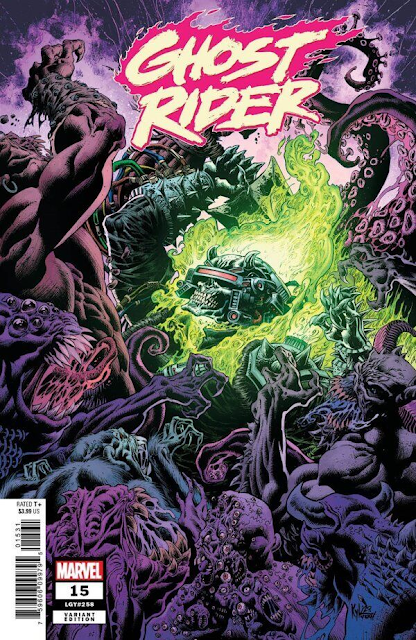
By the end of issue fourteen Dr. Diyu has nearly killed Danny by abusing his Ghost Rider power. Johnny and Talia arrive at the facility and Dr. Diyu panics and jumps inside a mech-suit (almost an AT-ST). Issue fifteen starts with Dr. Diyu stealing Danny's Ghost Rider and empowering her mech suit with it, leaving Danny practically dead when Johnny and Talia find him. Dr. Diyu passes through a portal into Hell to go rescue her brother. Johnny transforms into Ghost Rider and follows Dr. Diyu into Hell. Again, I'm sounding like a broken record here, but Cory Smith's artwork is incredible throughout this whole arc, especially here. Dr. Diyu finds her brother, but he's become a demon himself. Danny's Ghost Rider frees itself from Dr. Diyu's mech suit and leaves her stranded and helpless in Hell, her own brother about to kill her. 

Danny's Ghost Rider finds Johnny's Ghost Rider and it is then implied that both Ghost Riders maybe brothers as well. If we needed more evidence that these two Ghost Riders are not Zarathos or Noble Kale, this is it. The two Ghost Riders merge into one and they leave Hell. Once back on Earth, Johnny returns Danny's Ghost Rider to him, saving his brother's life. The final panel has Johnny reunited with Danny, Danny's eyes opening. This finishes the third story arc in the series and, sadly, is the last issue that Cory Smith fully illustrates himself in the series. Compared to the first two story arcs in the series, this one accomplishes very little, but does manage to clean up another mess left by Volume Nine. Sadder still, the volume only goes down from here.

Issue sixteen is a cool one-and-done story. It follows events in three different time periods featuring Johnny Blaze, Danny Ketch, and Robbie Reyes encountering the same hitchhiker. The hitchhiker possesses the bodies of the Ghost Riders, using their power to kill a cult of skinners, and then leaves. The artwork here is by Chris Campana and he does a fine job, but Cory Smith is certainly missed. Strangely, the issue doesn't address the fallout of the last story arc, Johnny and Danny having seemingly gone their separate ways for some unknown reason. There's a brief mention that Dr. Diyu's lab was destroyed, but nothing else. Disappointingly, this is the last Danny will appear in the volume as well. The epilogue sets up the next story arc.

The following arc is the crossover with the Wolverine book, also written by Ben Percy. The story picks up in a special one-shot issue titled Ghost Rider - Wolverine: Weapons of Vengeance Alpha. Then the story continues in Ghost Rider #17, Wolverine #36, and finishes in another one-shot special called Ghost Rider - Wolverine: Weapons of Vengeance Omega. Geoff Shaw provides the artwork for all four issues here and does a fine job. 

This story also takes place in multiple time periods, one set during the early days of Johnny Blaze's time as Ghost Rider, still trying to be a stunt cyclist for the Crash Simpson stunt show (this would place it somewhere during the first ten issues of Ghost Rider Volume Two published in the early 1970s) before he left Roxanne. The other time period being set in the present continuity. This retcon chronicles the first meeting of Johnny Blaze and Wolverine as they track down a demonic possessed mutant. This story feels unconnected to the greater narrative of the volume nor does it carry through to the final story arc of the volume. Back in the day, this would've been a one-issue story, a fun piece of filler between the central story arcs (coincidentally, all of these issues came out within a month of each other, so it was over and done with in the span of one issue). Overall, there isn't much to dig into here. Wolverine becomes a Ghost Rider briefly, that's about it.

This cover was by legendary Ghost Rider artist, Mark Texeira

Issue eighteen begins the final arc of the series. Carlos Nieto provides the artwork for issues eighteen, twenty, and twenty-one while Cory Smith and Brent Peeples share art duties on issue nineteen. This story arc shifts focus to Talia Warroad, exploring her past, present, and, ultimately, her future. This story arc also takes place across two time periods, this being the fourth time in the volume that the writer and editor have utilized this narrative structure. Also similar to the last arc, there is no reference to the previous story arc nor natural flow from one to the other. There is no plot thread laid down prior that this story arc follows from. The story just begins. For this being the final arc and the "culmination" of the volume it seems to carry little weight. By shifting focus heavily on to Talia's character, what weight it does carry is entirely dependent on the reader's attachment to her character. And just what is the reader's attachment to her character by this point?

HEROIC OR DESPICABLE?

Full discloser: the writer and editor have done very little to imbue Talia Warroad with anything positive.

Who is Talia Warroad? Her first act upon meeting Johnny is to drug him, cuff him to a bed, and mind-rape him. She kisses him without consent and later forces herself sexually upon him multiple times. She's forward with her advances yet never do we actually see Johnny himself initiating any reciprocation (he says he cares for her in issue ten but his actions rarely show it). And she never apologizes for her actions. Multiple characters validate her by saying "she's got balls," as in she's bold and brave (not that she literally has a pair of testicles) essentially telling the reader "like this character!" And on several occasions she forces Johnny's change into Ghost Rider, in effect, using Johnny and Ghost Rider for her own ends. When she and Johnny have their first real conversation she claims she has no guilt or shame, nor denial of her darkness yet it is revealed later that her actions contributed to the death of her parents. She justifies her actions as "sometimes you have to do bad things to make things good," implying the ends justify the means, a mentality that can be used to justify any act no matter how villainous. Maybe this personality is appealing to some, but it paints an image of an egotistical, sociopathic, self-centered, and abusive character.

This final story arc explores her backstory, devoting the lion's share of story to revealing her past. The half of the story in the past depicts her as a child seeing demonic entities in her room and her parents not believing her. This leads her down a path of hair dye, gothic fashion, and rebellious behavior. When her parents seek the help of Doctor Strange (demonstrating that they do in fact believe her) she refuses his help. She falls in with a delinquent crowd of "Lost Boys" types led by a boy named Stefan (who may or may not be Mephisto). Stefan teaches her black magic and tries to convince her to fully embrace the dark side (which she confessed to having done so earlier in the second story arc). Her hatred of her parents coupled with Mephisto's power endangers her parents and stains their home with demonic presences. When her parents are killed because of Stefan's dark magic, Talia leaves Stefan and again refuses Doctor Strange's offer of guidance and help.

Talia Warroad takes the spotlight, Ghost Rider struggling to stay relevant in his own comic

In the present, while on the road Talia gets wind of a Mephisto worshipping cult that sounds eerily similar to her experience with Stefan. Johnny and Talia set out to track the cult down. They come across a town where the children have been corrupted and have killed all of the adults (a la Children of the Corn). After freeing the children of demonic control, they continue across the country until arriving at the cult's central compound. Once again, Talia sexually uses Johnny to complete a spell allowing them access to the compound, but not before she belittles his trauma in favor of her own trauma (demonstrating her inability to look beyond herself). Johnny meekly forces her to see that, despite her trauma, it doesn't justify her actions or warped views of life. 

After fighting off demonic trees they get inside where Talia indeed finds Stefan, once more with children under his demonic thrall. Ghost Rider rescues the kids by literally "eating their sin," which isn't a power of his (or at least isn't a power of Zarathos'), while Talia confronts Stefan. Talia's solution is to condemn Stefan to Hell, stating that if she can do that she'll be able to die with no regrets. She says she's afraid of her parents' ghosts, but then expresses no regrets for contributing to their deaths. Nor does she try to rescue their souls from Hell, never once expressing a want to save anyone. She sacrifices nothing of herself in her attempt to solve the problem that, arguably, she herself created and instead runs away from her misdeeds by needlessly letting herself fall into Hell as well. She doesn't atone for her sins, but rather accepts them by saying, "My past has caught up with me." Johnny tries to reach her, but she makes no attempt to reach for him. Bizarrely, Johnny never expresses a desire to rescue her from Hell afterward. 

Taking all of Talia's character into account across this whole volume, she comes across as rather despicable. Yeah, she's helping Johnny eradicate demons across America, but in the end it comes out that she's only doing it to get back at Stefan and not for any heroic or altruistic motivation. By centering the final story arc on her, the book's finale feels hollow, with no heart or emotion. The reader is almost glad to see Talia's character go. But then, with this final story arc centering on her rather than Johnny, it leaves another troubling impression... namely that this book wasn't about Johnny Blaze. Johnny is treated like the sidekick in this final story arc, left to carry on Talia's mission in the wake of her death. His final sentiments are of self pity, in that anyone whoever gets close to him is destined for death. Self pity is what we're left with rather than motivation or, god forbid, hope. Volume Ten of Ghost Rider ends on a sour dismal note.


THE BONUS ISSUES

There's a Ghost Rider Volume Ten Annual featuring Johnny, Talia, and Elsa Bloodstone battling Parker Robbins: The Hood while he takes over Salem, Massachusetts on Halloween night. Ben Percy writes while featuring artwork by Danny Kim, the next future ongoing Ghost Rider artist. The story is a one-off with no connections to the ongoing narrative, coming across as a lighthearted seasonal Halloween special. Talia shows off boss level powers and abilities, at far greater levels than previously depicted, and is validated by Elsa Bloodstone as a strong capable woman who can take care of herself and doesn't need Johnny's help (which is something Elsa, if written to character, would never say nor give a crap about). Johnny is left to lasso a pumpkin-headed kaiju while Elsa and Talia take care of The Hood. All in all, this issue is inconsequential unless you're a fan of Talia and want to see her power on full display.

And there's a one-shot anniversary special issue titled Ghost Rider: Vengeance Forever, also written by Ben Percy with artwork by Juan Jose Ryp. This is an anthology style story featuring many characters at various points in the history of Ghost Rider. The framing sequence of the story features Johnny Blaze getting a full torso tattoo. Each tattoo tells a different Ghost Rider story. There's a glimpse of a prehistoric Ghost Rider bear, a female Ghost Rider being burned at the stake by pilgrims (during what appears to be a witch trial), a western Ghost Rider named Jimmy Underhill (to my knowledge this is a new Ghost Rider never before seen, yet is a reference to Ghost Rider's western cowboy roots) which we spend WAY too much time with considering he's not a part of the Ghost Rider publication history.

Then we get a short story with Danny Ketch battling Blackout set in the Volume Three era. There's a brief image of Mephisto and Lilith, Mother of Demons before showcasing a small story with Vengeance (Michael Badilino), Morbius, and Blade battling Dracula (an homage to the Midnight Sons). There's a scene with Robbie Reyes battling the Scarecrow in a cornfield (these two characters never met before nor would they have considering Robbie is based out of Los Angeles). And finally we get a glimpse into the future where Zero Cochrane a.k.a. Ghost Rider 2099 battles Zadkiel (again, two characters that haven't met before). As Johnny rides away after finishing his tattoo there is a last little panel featuring Frank Castle a.k.a. Cosmic Ghost Rider. The only ones left out of this special are both female Ghost Riders, Alejandra Jones and Kushala (strangely the one female Ghost Rider we do see in here is wholly original), then Wileaydus Autolycus (the original Cosmic Ghost Rider), Carter Slade (Marvel's very first Ghost Rider), and the Blazing Skull (not a Ghost Rider, but significant to the Ghost Rider legacy in Marvel publication). Plus the thousands of other Ghost Riders that writer Jason Aaron produced.

They managed to pack a lot in here and some of it is a welcome sight to see. Still, ultimately this issue is only skin deep, like a tattoo, and carries no narrative significance to the overall volume. Even the tattoos that Johnny receives are never referenced again, Johnny shedding his skin at the very end as he transforms into Ghost Rider (almost as if the writer is sending a meta-message that even he acknowledges that this is a "throw-away/cast-off" issue.

HIGHLIGHTS AND DISAPPOINTMENTS

You know I'm going to say it again; the artwork by Cory Smith is the star of this volume, shining brighter than any other aspect of the book. His contribution to this book can't be understated or undervalued. Yes, certain character designs were overdone, but that may not be his fault, rather it could've been direction from either the writer or editorial. His artistry of the character Exhaust is the sole reason why that character stands out. And his rendition of the corrupted Danny Ketch Ghost Rider is amazing. Johnny Blaze Ghost Rider looks great too, but the design is too bulky and KISS inspired. Dave Wachter and Chris Campana deliver standout artwork with each of their fill-in issues. Geoff Shaw's artwork for the Wolverine crossover is fine too, but by the time we get to Carlos Nieto's art in the last story arc, which is fine, the book has declined significantly in artwork.

The first three story arcs basically serve to clean up the messes left by Volume Nine. These story arcs flow naturally from one to the other and feel like equal parts of a greater narrative being woven. Yet they're far from perfect. Writer Ben Percy and editor Darren Shan insert political takes on America in the first ten issues, which don't really fit nor make sense with the plot. They push Talia Warroad yet can't seem to get her over in any endearing or meaningful way, and they break the tone and feel of the book with the goofy Hell's Backbone Rally story beat. And then they heavily borrow from Barry Windsor-Smith's Weapon X storyline for the third story arc, borderline plagiarizing, while simultaneously repeating a tired storyline for Danny Ketch for the third time. And the next two story arcs seem utterly divorced from the previous arcs and overarching narrative.

MISSED OPPORTUNITIES

Intriguing elements were set up in the first two story arcs that were inexplicably dropped. Zeb and The Council of Night Magicians was an interesting concept that could've led to bigger picture narrative beats, such as their purpose of monitoring the balance between light and shadow. Yet after issue ten these characters are forgotten completely. Also, what happened to Blackheart after issue ten? Also, what happened to Danny Ketch after issue fifteen? Johnny is finally reunited with Danny and Danny is cured of the Spirit of Corruption. Clearly Danny is too naïve to wander about on his own, so then why did Johnny just let him go? Or did he? We don't know because it is completely ignored by the following story arc. The one-off story in issue sixteen showcased a terrifying new character in the Hitchhiker and his cult of skinners while teasing a future team-up of Johnny, Danny, and Robbie Reyes which wasn't followed up on either.

And for what? A Wolverine crossover that bore absolutely no relevance to the ongoing narrative. And a major shift in focus to Talia Warroad which undercut Johnny's story and the overall narrative. And somehow painted Talia in an even more irredeemable light. Now, there's a chance that these characters and plot elements could be picked up in a future volume, but what Marvel has teased about the next volume suggests a different plotline altogether.


THE END?

Volume Ten comes to an end after twenty-one issues... or does it? Before the final issue of Volume Ten was even released Marvel announced Ghost Rider Volume Eleven was coming in March of 2024. Ben Percy was announced as the writer once more with artist Danny Kim (the artist of the annual we discussed above). The tease is that Johnny Blaze will lose the Spirit of Vengeance and a new character will become the Ghost Rider... again... because we need more Ghost Riders... Anyone wanna place bets that it'll be Talia Warroad? Has this announcement excited anyone?

WHAT TO EXPECT?

And Ben Percy continues writing too? This leads one to believe that Volume Ten isn't really ending, only continuing with a brand new #1 issue to boost sales. But with the same writer? Volume Ten certainly worsened in quality the longer it went on and if that downward trend continues into Volume Eleven we could be in store for another abysmal run on the level of Volume Nine or worse. Not to mention a repeat of past storylines where Johnny lost the Ghost Rider before (a storyline done to death even more times than Danny Ketch being manipulated by a badguy). And then we have to suffer the trope of yet a new Ghost Rider who is destined to fail before they've even debuted, only to have Johnny Blaze brought back once again as the central Ghost Rider to get the title back on track again. This is our negative outlook on this.

Now, for a more optimistic perspective; Ben Percy and Darren Shan could surprise us and do something really interesting with this setup. Perhaps the story begins with the Ghost Rider being taken by force and the new Ghost Rider is completely villainous. Johnny has to get the Ghost Rider back before terrible harm is done by this new Ghost Rider. Teaming with Danny Ketch, Vengeance (Michael Badilino), Morbius, Blade, and the Darkhold Redeemers, the reunited Midnight Sons go after this evil Ghost Rider. Danny Kim pencils the first few issues, but then Cory Smith returns for the second story arc and finale. Now, this is a story that would get us excited.

Which way do you think Ghost Rider Volume Eleven will go?


THE VERDICT

In summary, looking at this volume as a whole, it's not the worst volume of Ghost Rider, but it is far from the best. The key contributions of this volume to the overall Ghost Rider mythos is the cleaning up of Volume Nine's mess and Cory Smith's outstanding artwork. The writing and editing is all over the place, from glimpses of genius to outright uninspired plagiarism. There are times when the writer and editor demonstrate knowledge of the Ghost Rider mythos and other times where they don't. The first sixteen issues comprise the best of the volume. The rest feels rather superfluous and hollow.

KEY MOMENTS FOR THIS VOLUME

1) NEW POWERS

*Ghost Rider uses a flaming chainsaw & a flaming sword (multiple times throughout Volume Ten)*

*Ghost Rider "eats" people's sins (Ghost Rider Volume Ten #21)* 

*Ghost Rider can see a dead enemy's memories via his flaming stare (Ghost Rider Annual 2023)*

2) MAJOR ENEMIES

*Blackheart (Ghost Rider Volume Ten #5 - #10)*

*Exhaust (Ghost Rider Volume Ten #7 - #11)*

*Dr. Diyu & Infernal Labs (Ghost Rider Volume Ten #10 - #15)*

*The Hitchhiker & the Church of the Flayed (Ghost Rider Volume Ten #16)*

*Bram & Father Pike (Orchis member), the demon Bagra-Ghul (Weapons of Vengeance crossover)*

*Stefan & the Cult of Mephisto (Ghost Rider Volume Ten #18 - #21)*

*The Hood (Parker Robbins) & The Spirit of Halloween (Ghost Rider Volume Ten Annual 2023)*

5) ALLIES - GUEST STARS 

*Talia Warroad (Ghost Rider Volume Ten #1 - #21)*

*Zebadiah & the Council of Night Magicians (Ghost Rider Volume Ten #1 - #10)

*Danny Ketch (Ghost Rider Volume Ten #10 - #16)*

*Wolverine (Weapons of Vengeance crossover)*

*Elsa Bloodstone (Ghost Rider Volume Ten Annual 2023)*

And this is where I'll leave you for now. Thanks for following with us on this analysis of Ghost Rider Volume Ten. I know it was long but hopefully it was worth it. 


For more Ghost Rider articles, check out the posts below!


And as an extra bonus, here's one last bit I observed while reading Ghost Rider Volume Ten. 

This is a little aside diatribe for those interested, discussing a problem plaguing comic books, now more than it has in the past. It's a problem woven through the first ten issues of this volume of Ghost Rider. Thankfully it doesn't persist much beyond issue ten. Really, this is just a product of simple ham-fisted writing or editing, nothing more. But we'll go into it anyway.

ALLEGORY OR PROPAGANDA?

The United States in the Marvel Universe isn't the same United States in real life. It certainly mirrors the real America, but it is a fictional rendition of America. In the Marvel Universe there have been world-ending villains, planet-devouring aliens, monsters, demons, and more. While the America in Marvel mirrors the real America, it would be a very different country given what it has had to deal with and combat over the history of Marvel. Logically, the America of Marvel would be dealing with different issues and problems. 

Blackheart states, "This country was already a place of nightmares. Nobody even noticed we showed up." Spoken by the son of the devil, this line can be interpreted as lies spouted for the purpose of sowing discord and to shatter people's faith in their country. But this is not the first time the book has voiced this pessimistic sentiment of America in this volume, previously stated through Johnny Blaze himself as well as through the omniscient narrator. Across issues nine and ten there's a narration about how society ignores or turns its back on the country's problems, mowing our lawns, going about our daily lives like everything is fine when it's not. 

The narration goes on to say that "you can't simply blast a hellfire shotgun and take down what's deeply embedded, structural, systemic." One could take this as Ghost Rider describing how deeply rooted the demonic infestation is or, given the sentiments already presented earlier, this comes across as more indictments against the real America. Blackheart saying it is one thing, but having it said multiple times throughout, and through our protagonists as well, appears as though the writer himself is projecting his political sentiments, using this book as a platform for one-sided rhetoric. And the implication is that the cure for what ails America lies in people like Talia Warroad, a self-centered sociopath. At least, by the end of issue ten, the narrator explicitly says that Blackheart IS the root cancer that's metastasizing across the country, yet this feels like it was tacked on at the last minute.

Also, for a character like Johnny Blaze, given what he's experienced and what he's seen, it makes little sense for him to dwell on the problems of America when he's fully aware of the problems plaguing life itself on a divine scale. He knows the war between Heaven and Hell is real and ongoing. He's been to Hell. He's seen the inner machinations of demons and devils and their dark designs for humanity and the world at large. Greater than our earthly struggles, he's aware of the greater threat to our immortal souls. He's been at the heart of a battle for humanity's soul against supernatural horrors dwarfing any evil created by mankind. He intimately knows the true evil at work and has placed himself in opposition to cosmic horrors and dark forces threatening to consume all existence. For someone like this to take a moment, amid widespread demonic infestation, and bemoan the state of the union seems utterly moronic and horribly out of touch with what's really going on around him

The United States of America is not a perfect country nor has it ever been. This country has many problems, but what country doesn't? And, as far as I've read, the America of the Marvel Universe isn't dealing with the same problems that the America of today is. I'm not saying that comic books shouldn't tackle difficult subjects like the problems with America, but that it should fit with the world created therein and be a natural progression of the story being told. At the very least, set up this particular version of America in the story..

Science fiction and fantasy have often been used as allegorical tools for expressing social commentary. When used deftly the reader doesn't notice. When employed bluntly it becomes jarring, with the author's opinions and biases become fully transparent, taking the reader out of the story. Especially when only one side of the argument is explored. Sadly, this has become fairly typical of Marvel of late and a reason, one of many, why I don't buy nearly as many current Marvel comics books as I used to. Whether your personal politics align with the author's or not, this ham-fisted approach only serves to diminish the story being told, ruining the escapism and making it feel disingenuous or worse: like propaganda for one side of the aisle. And it doesn't matter which side of the aisle, right or left, it still has the same result.

Why the writer and editor placed any emphasis on this is a mystery. It isn't followed through in any meaningful way, it doesn't play into a greater overarching plot to follow, and it doesn't fit with the story or the Marvel universe as we know. Instead of giving this subject any time or thought at all, they could've applied that energy and effort into crafting a more cohesive narrative, servicing the characters, and better structuring the story to allow for more satisfying conclusions (I'm looking at you, finale battle with Blackheart). 

All right, I'm done talking about Ghost Rider Volume Ten... until we break down Ghost Rider Volume Eleven that is...

Until then...


KEEP THE FIRES BURNING, MY FELLOW RIDERS

Tuesday, January 9, 2024

GHOST RIDER - VOLUME 10 - BY BEN PERCY (2022 - 2023) ~ PART ONE

FIRE, BRIMSTONE, & EXHAUST -

GHOST RIDER VOLUME 10

Part One


In 2022, the year of Johnny Blaze's 50th anniversary, Marvel Comics announced a new volume of the Ghost Rider comic book to commemorate the occasion. Volume Ten is this anniversary volume. But before we get to there, we need to look at...

THE ROAD THUS FAR

The asphalt has been rough, bumpy, cracked, and littered with potholes for Ghost Rider comic books over the last ten years. Volume Six of Ghost Rider (which ran from 2006 to 2009 comprising 35 issues, a sequel mini series, a tie-in mini series, and an annual) was perhaps the last successful era for the character. Written by Daniel Way and succeeded by Jason Aaron, no volume since has had the longevity nor enthusiasm from readers surrounding it. Volume Seven saw the mantle of Ghost Rider pass from Johnny Blaze to a new character named Alejandra Jones (consisting of 10 issues and a six issue crossover). Then another new character became Ghost Rider named Robbie Reyes (who had two volumes: All New All Different Ghost Rider, which lasted twelve issues, and Robbie Reyes Ghost Rider, technically Volume Eight according to Marvel, which lasted five issues). 

Volume Nine saw Johnny Blaze return, a book that was hotly anticipated by yours truly given that it was being written by author Ed Brisson. That volume, sadly, was a disaster, lasting seven issues (interrupted by the pandemic) before being abruptly cancelled leaving the book incomplete. Eventually Volume Nine was unceremoniously tied up in a King In Black tie-in issue, an ignominious end to say the least.

I can't tell you the depths of my disappointment with Ed Brisson's run on Ghost Rider as it held maybe the most potential of any Ghost Rider volume in the ten years preceding it. That volume was the subject of a perfect storm of negative elements, the least of which being the interruption of the pandemic. Ghost Rider had been relegated to mere guest appearances here and there between volumes eight and nine, showing up in the Daredevil event series Shadowland and the Doctor Strange event series Damnation and then in a cool mini series called Spirits of Vengeance, the latter being the high point among it all.


THE 50th ANNIVERSARY ANNOUNCEMENT

While hope springs eternal, enthusiasm wilts after many repeated losses and losing seasons. And our trust in Marvel wavers after several mishandlings of the book. Marvel Comics of late certainly has lost the gold standard of approval with current comic books, as though the company as a whole has lost its way (or leadership has failed or led them astray). When this announcement for Volume Ten of Ghost Rider was made, it was declared that Johnny Blaze would once again be back in the saddle as the main Ghost Rider. Ever since the cancellation of Ghost Rider Volume Three (the Danny Ketch saga) Marvel has been trying to get Johnny Blaze over with readers as the main Ghost Rider. But they've forgotten what differentiated Johnny Blaze from the others, instead borrowing the powers and iconography of Danny Ketch. Not only has this not worked, but it also left Danny without a discernable identity whenever he returned to the story, seldom though it was.

Alejandra Jones and Robbie Reyes, while having their own merits, only served to muddy the already murky waters. And the dilution of the Ghost Rider brand has only continued with countless other Ghost Riders introduced over the last few years (many by writer Jason Aaron, another from writer Robbie Thompson, yet another by Donny Cates, with more to come so it seems). The premise of returning to the basics is instinctually a wise choice after a brand has been burned out, but going back to Johnny Blaze, the same tactic used so often in the past, has become so very tired. 

Yet who else could they go to? Danny Ketch seems the obvious choice, Volume Three historically being the most successful period in Ghost Rider's history. But Danny was left in a terrible state after Volume Nine and in dire need of repair. Alejandra Jones was killed off just prior to Volume Nine. And Robbie Reyes had just come off of two lackluster solo books (and was being used heavily in the concurrent Avengers book), although Marvel had been pushing the narrative that Robbie is the "ultimate" Ghost Rider. Needless to say, the Ghost Rider brand had been scorched so badly that Marvel didn't have much choice but to go back to Johnny.

The two creators, author Ben Percy and artist Cory Smith, were not household names in the comic community either. Not having read any of Ben Percy's work, and only a little familiar with Cory Smith's art, there seemed little to be excited about save for Cory Smith's artwork.

THE CREDITS AND WHAT'S INCLUDED

Who are the architects of this new series, you ask? Written in its entirety by author Ben Percy, with artist Cory Smith providing pencils for the majority of the issues (14 out of 21 regular issues). Brent Peeples provides pencils for one issue and assists with pencils on two more. David Wachter fills in for an issue, Chris Campana for another, Geoff Shaw penciling one issue, and Carlos Nieto penciling the final three issues. Bryan Valenza provides colors for 20 of the 21 issues with Oren Junior inking for 13 issues. The editor of this entire series is one Darren Shan with C.B. Cebulski as editor in chief.

This volume was supplemented with one annual issue (Ghost Rider Annual 1 2023), an anniversary special one-shot titled: Ghost Rider - Vengeance Forever, and a four part crossover with the concurrent Wolverine volume collectively referred to as Weapons of Vengeance (all of these also written by Ben Percy). This iteration of Ghost Rider also guest appears in Fantastic Four 2023 Annual and in three issues of the Daredevil & Echo four-issue mini-series. He also makes a one-page cameo in Doctor Strange #4 (August 2023). Lastly Ghost Rider is featured in a digital only release titled Strange Tales Ghost Rider Infinity Comic (October 2022). None of these guest appearances are written by Ben Percy or referenced in the actual Ghost Rider series, so, they are not essential to the series. All in all there are 26 issues comprising the complete story by Ben Percy and six extra issues for a total of 32 issues featuring this iteration of Ghost Rider (a nice size collection for an omnibus?). 

THE NONESSENTIAL APPEARANCES

Ghost Rider makes an appearance in Elektra: Black, White & Blood #4 which was published during this run, but does not feature Johnny Blaze Ghost Rider from this era, presumably taking place before Ghost Rider and Elektra's time together on the Thunderbolts (so, we're choosing not to count it, even as supplemental material, for this Ghost Rider volume). Ghost Rider also makes a comedic one-page cameo in Damage Control #1 (October 2022), but isn't sporting his redesign from this run, so, once again we're not including this appearance, even as supplemental material, for this Ghost Rider volume. Ghost Rider's appearance in Ziggy Pig and Silly Seal Infinity Comic #3 (September 2022) also is not included for the same reasons above.

More significantly, the four issue mini series Danny Ketch: Ghost Rider (published from July 2023 to October of 2023) prominently features Johnny Blaze in all four issues. This series takes place entirely within Ghost Rider Volume Three, Johnny Blaze represented in his incarnation from that era. While this story is important to the lore and certainly essential Ghost Rider reading, it has no bearing on Ghost Rider Volume Ten and, therefore, is deemed nonessential for this volume. 


VOLUME 10, THE GOOD, THE BAD, AND THE ABSURB

Readers beware: This is an overview of the series, spoilers, commentary, and analysis will ensue. 

Well, 21 issues, a crossover, and two one-shot specials later, Ghost Rider Volume Ten came to a close in December of 2023. Across the series comprised five different story arcs and three single issue self-contained stories. The first story arc wrapped up with issue six and smoothly transitioned into the second story arc which finished with issue ten, the last two pages teeing up the next arc. Issues eleven through fifteen complete the third arc. These first three arcs represent the most satisfying stories of the volume, flowing organically from one arc to the next, having deeper connectivity to the greater Ghost Rider mythology. The artwork from all of the artists across the volume is pretty solid throughout, showcasing gore and graphic violence, and quality rendering of skulls (believe it or not, how well the artists' draw Ghost Rider's skull is a big deal).

Issue sixteen is a one-off story and issue seventeen sets us off on the next arc, a crossover with Wolverine's comic book. From here on, sadly, the book dips in quality. The crossover with Wolverine comes across gimmicky with no organic transition from the previous arc nor feeling like the natural progression of the story Ben Percy had setup thus far. Luckily the story is four parts, only one issue actually taking place in Ghost Rider's series with the others occurring in two one-shot specials and one issue of Wolverine's book. So, by issue eighteen we're beginning the next and final story arc of the volume. This story arc, which should be the climax of the volume and the culmination of everything the volume had been building toward, shifts the primary focus from Johnny Blaze to Talia Warroad, Ghost Rider taking a backseat. With this being the climax of the volume, it left me wondering who this volume was really about? Was this volume of Ghost Rider really about Ghost Rider? Or was it about someone else entirely? 

Let's get into the details, shall we?

THE STORY

The story begins with Johnny Blaze finding himself in the life he always wanted; living the American dream with his wife, Roxanne, his two children, Craig and Emma, and working for his adoptive father, Crash Simpson. Yet, there's an itch in the back of Johnny's mind, something telling him that this heaven is really a hell. He's having visions of demons randomly and scratching at a strange scar along the back of his head. And there's no sign nor memory of the Ghost Rider. We're introduced to a mysterious new character named Zeb who offers to wake Johnny up from this nightmare he's found himself in, saying the Ghost Rider is needed. Taking Zeb's offer, the Ghost Rider is set free and Johnny finds himself in a town filled with demons. Elsewhere, we're introduced to another new character, an FBI agent who hunts monsters. This FBI agent's name is Talia Warroad. Back to the city of demons, Ghost Rider lays waste to the town and sets out to discover who had imprisoned him. And deliver his infernal judgement upon them.

This all occurs in the first issue, an oversized comic book that amounts to a satisfying read. Dropping Johnny and us readers into a new setting made for a compelling beginning without forcing the story to directly address the mess that was left behind by Volume Nine. By featuring Crash Simpson, Roxanne, Craig, and Emma, despite them being fakes, it displayed the competency of the writer and or editor, that Ben Percy or Darren Shan had at least done some research of the Ghost Rider mythology. For longtime readers this left us feeling reassured that our beloved characters, so often mishandled of late, were in good capable hands. 


The following issues in this first story arc (#2 through #6) feature Ghost Rider traveling from town to town hunting down demons and eradicating them. Issues one through four are primarily self-contained stories with B and C plots running in the background. The A plot focuses on Ghost Rider and his freeing of towns from demons all the while trying to figure out the big picture. The B plot involves Talia Warroad and her FBI partner slowly closing in on Ghost Rider. The C plot revolves around the mystery of Zeb, full name: Zebadiah, and the introduction of yet more new characters, a group of five calling themselves The Council of Night Magicians. They seem motivated to free Ghost Rider from his demonic prison for the purpose of reestablishing supernatural order to the world. 

Of particular note; Issue four sees Johnny facing off against the Circus of Crime. For longtime readers, we know that the circus carries great meaning to Johnny Blaze. A big portion of his life was spent with a traveling circus, the Quentin Carnival, where he worked for many years and eventually owned and operated it alongside Roxanne. There was even a pivotal story arc where the Quentin Carnival faced off against the Circus of Crime. Sadly, there is no mention of that in this issue, nor does Johnny seem to recall or recognize the characters or events, merely the general recognition of circus atmosphere. The knowledge of the writer and editor is betrayed here and the confidence of the readers is slightly eroded (not significantly, but somewhat). The circus/carnival environment is very significant to Johnny Blaze's character and no acknowledgement of that whatsoever is glaring. Otherwise it's a fine issue.

Issue five stands out as perhaps the most absurd issue in the entire volume, a story which so far had been treated quite seriously until now. We get a quote from The Fast And The Furious franchise here, "Ride or Die" before Ghost Rider enters a race called the Hell's Backbone Rally alongside a who's who of characters across the Marvel universe. In perhaps one of the most ludicrous panels I've ever seen, we're shown Ghost Rider in a group of motorcyclists consisting of Dr. Doom, Man-Thing, the Rhino, Dracula, Blade, Moon Knight, and Elektra among others, all astride their own unique motorcycles. Wolverine, Kraven the Hunter, Bullseye, Black Widow, Multiple Man, Boom Boom, and more are shown later, all racing along Hell's Backbone. The allure of this race is that the winner is allowed council with the Devil and granted anything they wish for. The race is as ridiculous as the cast of characters too. Johnny's scar along his head begins opening and a demon begins spilling out. Wolverine comes to Johnny's rescue, carting Johnny away to safety.

Is this cool? Or is this dumb? My gut reactions is that this concept is incredibly stupid.

The B and C plots intersect in this issue, Talia summoning Zebadiah and learning that the Council of Night Magicians is working to restore the balance of Light and Shadow in the world. He reveals to Talia that they're on the same side and that she's targeting the wrong people. It's here where Talia's FBI partner reveals himself to be a demon in disguise. This is an intriguing development with potential for the future. Also revealed at the end of the issue is the mastermind behind the demon infestation across America: Blackheart, the son of Mephisto. Blackheart's reveal here is pretty epic to see. His appearance goes a long way to repairing some of the lost goodwill of us longtime readers from issue four.

Issue six reveals a traitor within the Council of Night Magicians, the leader of the council being in league with the demons. Zeb and Talia join forces and escape. Meanwhile, Wolverine takes Johnny to a bar where he performs impromptu surgery, removing the invading demon inside Johnny like cutting out a tumor, thus fully freeing Ghost Rider. This itself continues the nonsense from the previous issue in that exorcising a demon is not a spiritual act but rather can be done by Wolverine of all people. But then, this book's approach to demonic possession was never made clear, vaguely defined at best. 

Issue seven begins by introducing a new villain named Exhaust: the demon that Wolverine pulled out of Ghost Rider crawls inside the body of the bartender and transforms into a monstrous amalgamation of exhaust pipes, motorcycle engine parts, human flesh, and bone. Not going to lie, Exhaust's character design looks badass and feels like something that would have come out of Howard Mackie's seminal Ghost Rider run (Volume Three). He's a welcomed addition, at least visually, to Ghost Rider's rogues gallery and maybe the best designed new character in the entire volume.


 Talia and Johnny finally meet in this issue in a rather unsavory way. Talia possesses a waitress at a diner, slips Johnny a roofie, and then handcuffs him to a bed before using magic to spiritually and mentally rape him (her physical assault of him comes later). While she mystically violates him without consent, we get a cool recap of events, cool because of Cory Smith's incredible artwork in four back to back full page spreads. In this recap it not only covers the events of Volume Ten so far (a little redundant), but we also are treated to an amazing full page spread of Ghost Rider sitting on the throne of Hell (referencing events from Volume Nine) and then a full page spread of Blackheart seated atop a mound of skulls (in what I feel is one of the best images of the character ever rendered). Talia probes deeper and uncovers how Johnny was deceived by Blackheart, how Ghost Rider was sealed away, and how Johnny came to be trapped in that hell disguised as paradise in issue one.

I have to give due recognition to writer Ben Percy and editor Darren Shan here for this great piece of  continuity and plot. When this volume began we readers were given the impression that the book was either ignoring the messy events of Volume Nine or disregarding that story entirely. Rather, this issue acts as a stealth follow-up to Volume Nine, revealing that Blackheart (who pretended to ally himself with Ghost Rider in Volume Nine) enacted a revenge plot against Ghost Rider for taking the throne of Hell. And these first two arcs of Volume Ten are the fallout of Blackheart's plan. This was nicely crafted and executed, including one nightmarish sequence of Blackheart's arm reaching out from beneath a bed and dragging Johnny, screaming in terror, into the darkness. This was mostly executed nicely and wonderfully rendered, so, a big bravo to the creative team!

Johnny wakes, still handcuffed to the bed, and he and Talia finally talk. She explains what she's learned from scouring his mind (something for which she does not apologize for) and the two finally join forces. Pivoting back to the Hell's Backbone Rally and the race (which the story seemed to have forgotten until now), showing those who finished (conveniently none of the recognizable characters who participated are present) gathering around Blackheart, including Exhaust whom Blackheart describes as Ghost Rider's shadow. The prince of Hell reveals his ultimate plan: If he can't be king of Hell then he'll spread never-ending darkness across America turning it into his own hellish kingdom.


Issue seven is a huge comic in terms of story development, as evident by the long analysis here. Issue eight begins with Johnny and Talia studying their "evidence web" pinned to the wall, trying to figure out what their next move will be. Johnny figures out Blackheart's pattern with all signs pointing to Chicago as the next town to be attacked by demons. We briefly shift scenes to the Council of Night Magicians, seeing the aftermath of Zeb's battle with the treacherous leader, Alabaster, Zeb being the victor. We return to Johnny and Talia being attacked on the road by zombie animals, all created by Exhaust. Flash over to Zeb and the remains of the council, they discover that Alabaster had been in league with Blackheart all along. Meanwhile Johnny and Talia arrive in Chicago where Talia uses her magic to force Johnny to change into Ghost Rider.

Issue nine begins with Ghost Rider and Talia making a deal. They continue through Chicago, find a desecrated church filled with corpses, and head down a subway tunnel finding it filled with human sacrifices and demons. Ghost Rider starts up a fiery chainsaw and starts mowing through the demons while Talia is attacked in the shadows by Exhaust. Meanwhile Zeb and the remaining members of the Council of Night Magicians track down Blackheart. Leading into issue ten, the penultimate issue of this story, the issue begins with Ghost Rider continuing fighting the demons. Meanwhile Blackheart lays out his plan to Zeb and the council, detailing how his demons have infiltrated the government, church, business, industry, and virtually all essential areas of society. Zeb and the council attack Blackheart from all sides only to be defeated by the son of the devil.

Back in the Chicago subway system, Ghost Rider finishes off the demons and then battles Exhaust and a possessed Talia Warroad. Seeing Talia "corrupted," Johnny realizes he's come to care for her dearly. He begs Ghost Rider to withdraw and let Johnny himself deal with Talia and Exhaust. Ghost Rider refuses, but Johnny exerts full control and forces the transformation back. Once human again, Johnny utters an impassioned plea to Talia's heart, which enables her to overcome her possession. Together Johnny and Talia defeat Exhaust and whisk away back to Utah and to Hell's Backbone to confront Blackheart. 

Ghost Rider's bad dad joke and one-hit kill on Blackheart... 'sigh'

Ghost Rider and Blackheart finally come face to face in the climactic showdown. Blackheart hurls one bolt of blue energy which is effortlessly caught and crushed by Ghost Rider. After uttering maybe some of the worst lines of dialog the character has ever said, Ghost Rider calls down a mountain-sized column of fire out of the overhead storm clouds upon Blackheart's head and the son of the devil is no more. Zeb, Talia, and Johnny watch Blackheart burn, declaring they're going to continue their battle against the "shadows" of this country. What follows is five pages of resolution: Talia resigns from the FBI, joins Johnny for a cute little scene before they set off towards one of the remaining towns infested with demons: Savannah, Georgia. We're then introduced to a new character named Dr. Diyu working in a secret government lab performing bloody autopsies on demons, her next test subject being: DANNY KETCH.

Really? After all of that, the big finale is one puny fireball from Blackheart and then Ghost Rider takes him out in one shot? This is an ability neither previously alluded to nor something he should be capable of. This book has done many things well, but issue ten, aside from gorgeous artwork, is a big disappointment, especially considering its the culmination of the plot that began with issue one. The issue is poorly structured, spending too much time on the subway battle with the demons and the confrontation with Exhaust. The author practically uses the book as a platform for his political beliefs, the veil between allegory and political rhetoric growing thin with both Blackheart's dialog and the narration. There's laughable dialog from Ghost Rider and an unearned relationship development between Talia and Johnny. 

And by the end of it no space is allotted for the final boss fight against Blackheart save for two pages. Even the fight between Blackheart and the Council of Night Magicians lasts a mere two pages, most of it occurring off panel. The battle with Exhaust barely happens either, Ghost Rider nary getting a hit in before it shifts focus to Talia for five pages. If this had been extended into two issues, crafting epic confrontations with Exhaust and an even greater battle with Blackheart, it could've felt more satisfying. As is, this issue ends on a lackluster note, saved only by Cory Smith's artwork. Johnny and Blackheart have never really had a climactic battle, Blackheart having primarily fought against Danny Ketch and briefly against Alejandra Jones. What could've been Johnny Blaze's own epic battle with Blackheart feels barely thought out and lazily crafted. 


HIGHLIGHTS & KEY TAKEAWAYS

Concerning only these first ten issues and the story presented in them, Ghost Rider Volume Ten finishes its first year fairly positively. Cory Smith's artwork is the MVP of this volume, shining as perhaps the best artist to take on the character in the last 15 years or more. Smith's dark, gritty, detailed, and realistic style works so very well with Ghost Rider, the tone, and subject matter. Cory Smith is a perfect fit.

The character designs are mostly on point, with a few designs not quite hitting for me. The design for Ghost Rider himself looks fairly good, but goes a little over the top in areas. Specifically, he's a little too bulky, not in a muscle-bound way, but a puffy way. His Frankenstein boots, spikey knee pads and elbow pads, and the thick spikes on his shoulders all go a bit too far for my tastes, Ghost Rider looking like a band member of KISS or GWAR (both of these bands are awesome, but this isn't how Ghost Rider should look). Cory Smith's artwork and talent are not the problem, it's that the design needs to be reined in a bit. Also, Ghost Rider's motorcycle design is a little weak too and more reminiscent of Danny's bike, not Johnny's bike.

Talia Warroad's design looks like every goth cliché rolled into one. It goes to far over the top, again in need of reining in. All of the elements present add up to just too much. Scaled back, the design could work better, but the character's personality isn't helping the design any either. Conversely, Blackheart is absolutely perfect, yet nothing was changed from his classic design, proving that you don't necessarily need to change any of the characters' designs, only requiring a great artist to bring out the best in the designs. The new character Exhaust's design is nigh perfect too, not a single complaint from me here. The demons and monsters in general all look really good in these first ten issues.

As for the story and plot execution, I felt it hit more than it missed. Without going over it again, the first four issues flow pretty nicely together, starting fresh, opting for a seemingly blank slate at the beginning, taking the story back to the basics. Points awarded to the writer and editor for referencing Roxanne, Craig, Emma, and Crash Simpson, but then points are docked later in issue four for not acknowledging Johnny's past with the Quentin Carnival. Issue five is the low point of these ten issues, feeling tonally jarring and out of place with the relative seriousness of the series. But the reveal of Blackheart at the end of issue five was a big positive, points awarded again.


Issue seven is perhaps the standout issue here, connecting with the previous volume, providing context for the first issue, and laying out Blackheart's plan. Also, the introduction of Exhaust pushed the issue further into something truly epic. The next three issues don't quite reach the same heights, but neither do they fall flat on their faces. Issue ten, the climax, left a lot to be desired and is runner up for the low point of the series thus far. It was an oversized issue, but still needed more space to properly deliver on all of the elements therein. What really hurts this issue is the "blink and you'll miss it" end boss fight between Ghost Rider and Blackheart. Truly disappointing, borderline insulting as far as climaxes go.

All in all, there's a lot to like here, but also much to improve upon. For the art, a little less with the character designs. For the story, a little better pacing and structure and a little more depth to the story in regards to Johnny's character. Other than that, so far it's an improvement over the last several volumes, better than Volume Nine, both Robbie Reyes' volumes, and Alejandra Jones' volume. But still not quite up to the level of volumes two, three, or six.

Sorry for rambling on so long. Needed to make sure we presented all of the evidence and gave this book a fair assessment. The second part will finish this volume. 

Will this reach legendary heights, becoming the next great volume of Ghost Rider?

Be sure to check PART TWO coming soon!

And for more Ghost Rider centric posts, check out these links below!


Wednesday, December 6, 2023

THE SAGA OF THE KING OF THE MONSTERS ~ PART 34: GODZILLA MINUS ONE (2023)

GODZILLA MINUS ONE (2023)


Few franchises mean more to me than the Godzilla franchise. I first encountered this character at a tender age of three or four (my memory has it at age 4 but I have documented evidence of me holding my first Godzilla toy at age 3. Memory is a funny thing). Over thirty years later my love for Godzilla has only grown greater still. My heart truly lies with the Godzilla films I grew up with, namely the Showa era films (1954 through 1975) and the Heisei era (1984 through 1995). I can remember a time when there were no other Godzilla films after Godzilla 1985 (that's how far back my fandom goes). I do enjoy most of the Millennium series too (1999 through 2004). There are ups and down, certain films I like better than others, sure, but I do enjoy nearly all of these films. 

The last twenty years of Godzilla films have been interesting and, dare I say, the most uneven and inconsistent in the entire franchise. I'd call this the "Experimental" phase of Godzilla's history. The American made Monsterverse being its own thing entirely, looking solely at the Japanese Godzilla material shows a company that doesn't quite know what to do with this cinematic icon. There's a reason why I haven't reviewed (or finished watching) GODZILLA SINGULAR POINT yet as I'm just burnt out on these "new takes" and wildly different interpretations. I'll get to Singular Point eventually, but I have no real drive to watch it, which is a first for me with Godzilla.

Shin Godzilla, the last true Godzilla film, was fine. It was another of these experimental Godzilla films that's a fine diversion for a time, but nothing I want to see regularly from the series. I have only seen one film from director Takashi Yamazaki, the director of GODZILLA MINUS ONE. That film was LUPIN III: THE FIRST and I loved it. This gave me hope for Godzilla Minus One. I'm happy to say that Godzilla Minus One did not disappoint. 

THE SYNOPSIS

During the final days of World War II a lone kamakazi pilot lands on Odo Island, afraid to follow through with his mission. While there a giant monster comes ashore. Having a chance to kill the beast, the pilot once again succumbs to fear and lets the monster live only to see it kill everyone else on the island. Finally returning to mainland Japan after the closing of the war, he discovers the devastation wrought by the atomic bombs, having lost his family home and parents in the bombing. Stumbling upon other survivors in need, he inadvertently finds himself with a new family. 

Two years later they have started piecing their lives back together, finally finding a way forward. Suddenly a monster rises out of the sea, wreaking enough damage to rival the nuclear holocaust of the war. He realizes that this is the same creature he had a chance to kill on Odo Island, now mutated and much much bigger. He finds that his nation needs him again, perhaps to once more, make the ultimate sacrifice. Still rebuilding the nation from being knocked down to zero after the war, Godzilla could take them even lower still... Minus One.

Artwork by John Dunn

INITIAL REACTION

The original Godzilla movie from 1954 was very much a film about Japan coming to grips with what happened to them, the one and only nation in history to have a nuclear bomb dropped on them. Suffering through the aftermath of poisonous radiation, an invisible killer ravaging their land and people too; Godzilla was a way of giving form to all of this. Through the film Godzilla gave them something to project all of the fear and anxiety being felt throughout the nation upon. There is no other film in the series quite like the original. The subsequent films, while wonderful in their own rights, have never quite carried the same weight or meaning.

Godzilla Minus One is the first film in the series to be set in this period, even earlier than the original film. Set in 1945 through 1947, during and immediately after World War II, allows the story to once more capture the fears and anxieties that gave birth to Godzilla in 1954. As a result Godzilla Minus One feels the most akin to the original concept and allegory of the 1954 film. At long last, this iteration feels like Godzilla, the real Godzilla. No other film in the nearly 70 year history of the franchise comes quite as close to matching the original film as Godzilla Minus One. And it feels like this could have only been achieved by setting the story in this time period. To me, if you're beginning to rebuild the franchise with a new saga, setting the first film in this time period is perfect.

KAIJU FILM OR DRAMA?

This film isn't a monster movie. This is a human drama of the highest quality, emotionally profound and culturally significant. Once more Godzilla is used as an allegory for post war anxieties, helping Japan come to grips with what happened during World War II, and displaying a hopeful message that they can move forward as a nation after this. The fact that he's a kaiju is irrelevant. He merely represents a common foe to unite them once again, but to fight for the right reasons. The guilt the Japanese carried  and how to move forward after what happened in the war is the real story here. The human characters and their journeys back from the brink of the war are the backbone of this film. This is very much a life affirming story, healing the soul of a nation. One could even consider the film a war epic with humanity at the center of it all.

That being said, there is an imbalance. This film focuses intently on the human drama, and it is precisely this human drama that connects to us as an audience, and makes this film so great. I wouldn't change that at all. Yet this makes it weaker on the monster spectacle. The monster is clearly not the focus of the film, but rather the fulcrum moving it forward. As a result of this, personally I feel this isn't really Godzilla's film. He could be substituted out easily and the movie would still play out the same way. Everyone's mileage will vary on this, some might say that the human drama here is what makes this movie great, not the monster. For me, I see this film as a fine piece of cinematic art, maybe among the greatest, but not so much as a kaiju film. 


STYLE VS SUBSTANCE

The deeper meanings of these films are essential and, for some, the reason to revisit them again and again. That opinion is not wrong, although I'd say as a piece of entertainment and kaiju cinema, it may feel deficient for some. Having a deeper meaning or not, let alone having a wonderful human story, doesn't necessarily make for a great piece of entertainment. To make up for this imbalance I would've loved to have had more scenes with the monster. No matter what your thoughts and feelings are about the Godzilla series, monsters are a central part of them, an equally key component, and this one was light on this aspect. It's what makes a kaiju film a kaiju film versus a period piece war drama that just happens to have a monster in it.

Alternatively we could look at this seeming lack of cinematic spectacle a different way. For years now Hollywood has been supplying us with cinematic spectacle after cinematic spectacle, leaning more on the spectacle and less on the substance behind the spectacle. At some point the spectacle becomes hollow, losing it's magnificence, as a result of having no substance. Conversely, Godzilla Minus One, by having such engaging and powerful substance behind it, lends its few scenes of spectacle far more gravity and awe. Godzilla Minus One relies more on substance and less on spectacle, giving its audience something truly substantial to feast upon. Quality spectacle versus quantity. More protein, less unhealthy sugars. From this perspective, Godzilla Minus One is even more amazing. The more the movie sits with me the more I subscribe to this idea, despite feeling like I needed more kaiju spectacle.  

But what of the spectacle and kaiju scenes that we did get? The monster scenes are all incredible. Every scene that Godzilla is in is either frightening, shocking, or mouth-droppingly powerful. Every scene Godzilla is in has meaning and purpose. Each scene is evolving some aspect of Godzilla or moving the story forward, not a single wasted moment. It really is a case of quality over quantity. Like the human drama, each scene with Godzilla carries weight and has impact.


A Godzilla Fan Detail 

This next part might seem minor to some, but it means a great deal to someone like me. A huge factor in every one of these films, whether American or Japanese, is Godzilla's design. As trivial as this may sound, Godzilla's design can either make or break a Godzilla movie for me. Godzilla is more than just a name you can slap on just any old character, he is a world recognized icon. Thus it makes sense to say that he has a specific image in our collective consciousness. Stray too much from this image and it simply isn't Godzilla anymore. Case and point: Godzilla 1998. The design can be played with and altered to a degree, yes, but ultimately there are particular traits that need to be maintained. His general shape, the dorsal plates, his mouth, his feet, when altered to too extreme a degree it ceases to be Godzilla. 

All of this is a longwinded explanation to justify why the design of Godzilla is so important and an aspect I place great emphasis on with each film. The 1998 iteration was so far afield it didn't feel at all like Godzilla to me. 2004's was too slim and rubbery. The 2014 iteration, the first in the Monsterverse series, missed the mark with the bland dorsal plates, alligator-like snout, and elephantine legs and feet. The 2019 Monsterverse design improved extensively, only to be undone by the 2021 iteration. Shin Godzilla was closer in some aspects yet too extreme in others. "Planet-Godzilla" also lacked specific details to really shine as a design and Singular Point took certain body features to exaggerated proportions. The design in Godzilla Minus One, however, is very good, in my opinion, one of the best designs, if not the best, since 2003. Equally iconic and a key component is his roar. His roar isn't perfect here, but it's close.

THE VERDICT

The king of the monsters has been in a strange place for the last ten years. There is something decidedly off with the Monsterverse Godzilla that makes him feel not entirely authentic. After Shin Godzilla, the Godzilla Planet trilogy, and Singular Point, I wasn't sure Toho could do a traditional Godzilla film again nor if they had any interest in doing so. Needless to say, going into this film I was worried if another beloved franchise was going to continue down a disappointing path.

Godzilla Minus One somehow managed to embrace an almost completely traditional approach, capturing the power and pathos that made the original film an enduring classic while simultaneously feeling refreshing. The film in unabashedly Japanese yet the characters' stories and struggles are universally felt and empathized with. Godzilla is terrifying and powerful, the threat to Japan and its people palpable. In summary, this movie is incredibly well made and is the great "return to form" I'd been longing for.

Overall Ranking: 9 out of 10

The only thing holding Godzilla Minus One back from being perfect is that our titular kaiju could use a little more screen time. That's all. All in all, this is the proper way to curate and care for a world beloved icon and long-enduring franchise.


For more of my thoughts on the Godzilla series and all things kaiju and related, check out the posts below

GAMERA REBIRTH (2023)

SHIN GODZILLA (2016)

SHIN ULTRAMAN (2022)

SHIN KAMEN RIDER (2023)

THE SAGA OF THE KING OF THE MONSTERS 
 
Part 8: Son Of Godzilla (1967)
Part 9: Destroy All Monsters (1968)
Part 10: Godzilla's Revenge (1969)   
Part 11: Godzilla Vs The Smog Monster (1971)  
Part 12: Godzilla Vs Gigan (1972)    
Part 13: Godzilla Vs Megalon (1973)  
Part 14: Godzilla Vs Mechagodzilla (1974)  
Part 15: Terror of Mechagodzilla (1975)      
Part 16: The Return of Godzilla (1984)   
Part 17: Godzilla Vs Biollante (1989)       
Part 18: Godzilla Vs King Ghidorah (1991)     
Part 19: Godzilla Vs Mothra (1992)        
Part 20: Godzilla Vs Mechagodzilla II (1993)
Part 21: Godzilla Vs Spacegodzilla (1994)
Part 22: Godzilla Vs Destoroyah (1995)
Part ???? Tri-Star's Godzilla (1998)
Part 23: Godzilla 2000 (1999)
Part 24: Godzilla Vs Megaguirus (2000)
Part 25: GMK Giant Monsters All-Out Attack (2001)
Part 26: Godzilla Against Mechagodzilla (2002)
Part 27: Godzilla: Tokyo S.O.S. (2003)
Part 28: Godzilla: Final Wars (2004)       


LONG LIVE GIANT MONSTERS!